
START it UP - CNS
Hockey is regularly lumped in with other “field invasion sports,” as if it shares the exact same neural demands as football or rugby. It doesn’t. It’s a sport where a hard projectile can travel faster than most athletes can process, manipulated via a one‑metre lever in a compressed space with 360° threats. That combination makes hockey one of the most Central Nervous System (CNS) ‑ hostile sports currently played. It is simply not football, and constantly copying and pasting sports science memes across to hockey is a seriously flawed practice.
Football clubs like Arsenal now use CNS‑priming warm‑ups that blend low‑load explosive work, scanning, and partner‑coordination drills to “switch on” the system without fatigue. That’s a great baseline. But for hockey, it’s not enough. This article builds the case—neuroscientifically and practically—for full‑range CNS activation in hockey as an integral part of training and pre-match priming of integrated body systems.
Hockey is an intermittent, high‑intensity sport characterised by repeated accelerations, decelerations, and multidirectional changes of direction layered over complex stick–ball actions.
The typical match exposes players to:
High frequencies of accelerate–brake–reorient sequences
Continuous tactical reshaping of space
Rapid transitions between low crouched and upright postures
Repeated fine‑motor stick manipulations at high speed
Additionally, the cognitive load of a competitive match is substantial. Malcolm et al. (2022) have shown that a single competitive field hockey match measurably altered players’ cognitive performance. Specifically, that a single competitive field hockey match impaired several aspects of cognitive performance immediately after play, including slower reaction times and reduced executive function.
Without sounding like Captain Obvious,player’s slower response times late in the game are down to acute CNS fatigue and reduced processing speed. Executive function tasks — which involve inhibition, switching, and working memory — showed:
reduced accuracy
slower performance
greater variability
These are classic signs of central fatigue and reduced cognitive control.
For the dedicated hive of sports sci undergrads that read this content, you will be pleased to know the authors also measured blood biomarkers before and after the match:
Adrenaline ↑
Noradrenaline ↑
Cortisol ↑
BDNF (brain‑derived neurotrophic factor) ↑
Cathepsin B ↑
These indicate:
high sympathetic activation
metabolic stress
acute neural plasticity signals
CNS load
eam‑sport matches impose high cognitive and physiological load repeated exposure could lead to cumulative cognitive fatigue
This underscores how demanding the sport is on the faculties of attention, working memory, and executive control.
It is not unreasonable or contrary to first hand experiences to realise hockey matches impose high cognitive and physiological load and that repeated exposure could lead to cumulative cognitive fatigue. Tournament play is the classic CNS exhaustion cauldron.
Decision density and neuromechanical chaos
Field hockey is an intermittent, high‑intensity sport with repeated accelerations, decelerations, and multidirectional changes of direction layered over complex stick–ball actions; (Agility 2021).
The typical match exposes players to:
High frequencies of accelerate–brake–reorient sequences
Continuous tactical reshaping of space
Rapid transitions between low crouched and upright postures
Repeated fine‑motor stick manipulations at high speed
Additionally, the cognitive load during competitive matches is substantial. Malcolm et al. (2022) showed that a single competitive field hockey match measurably altered players’ cognitive performance, underscoring how demanding the sport is for attention, working memory, and executive control.
Perceptual–cognitive work in youth and international hockey confirms the obvious lived reality: physical and technical qualities are necessary but not sufficient; decision‑making and perceptual–cognitive skills discriminate more clearly between higher and lower performers in fast‑paced contexts, Timmerman,Farrow,& Savelsbergh (2017); Drake & Breslin (2018).
Stick sports and extended interaction space
Unlike football, where the foot directly contacts the ball, a hockey player operates via a 1 m+ stick. This turns every action into a chained control problem: hand → wrist → forearm → shoulder → trunk → stick → ball → opponent → space. The neuromechanical literature on hockey stick speed and ball control shows that even “simple” drills entail high‑frequency, high‑speed stick–ball events that differentiate novices from state‑level players; Thiel, Tremayne & James. (2012).
From a CNS point of view, this means every decision is implemented through a distal tool, not a proximal limb. That matters for how the brain represents the body and space and how skills are acquired and executed.
The neuroscience of CNS priming and why it belongs in hockey
2.1 Cognitive priming during warm‑up
A recent open‑access study on cognitive priming during warm‑ups demonstrated that integrating cognitive tasks (e.g., reaction, decision, working memory) into physical warm‑ups can enhance sport and exercise performance via a “Goldilocks effect”—too little cognitive demand adds nothing; too much becomes detrimental, Díaz-García et al, (2025).
When cognitive load is tuned correctly, warmup becomes a neural preparation block rather than just a form of tissue temperature work or slowly boiling frog copy and paste coach syndrome.
Media summaries from the University of Birmingham and others have highlighted that this effect persists even under sleep restriction, meaning that well‑designed cognitive–physical warm‑ups can partially offset mental fatigue and sharpen readiness. This is crucial to bear in mind when planning a tournament campaign away from home. For a CNS‑dense sport like hockey, this is not a curiosity—it is a direct invitation to engineer warm‑ups that deliberately load perception, attention, and anticipation under controlled conditions.
Processing speed, reaction time, and decision time
Decision making in hockey is rarely limited by maximal strength or VO₂; it is limited by processing speed under spatiotemporal pressure. Cano et al. (2024) used decision‑time analysis to show that athletes’ processing speed during motor reaction tasks can be cleanly quantified and varies meaningfully across individuals.
Meta‑analytic work shows that anticipation is one of the strongest differentiators between elite and sub‑elite performers across sports (Song et al., 2025; Harris et al., 2022; Zhu et al., 2024).
Decision‑making reviews in sport emphasize the roles of attention, prioritisation, and memory in high‑speed, dynamic environments—exactly the cognitive ecosystem of hockey circle defence or midfield interception.
Taken together:
CNS priming can acutely enhance performance when tuned correctly.
Processing speed and reaction time are trainable.
Decision‑making quality depends on how attention and memory are configured in the moment
Warm‑up, then, is an opportunity to shape the state of the body’s total systems, not just heat tissues and oxygenate or give the Assistant Coach something to do.
Perceptual–cognitive training improves anticipation and decisions
A systematic review and meta‑analysis of perceptual–cognitive training in team sports concluded that such training can meaningfully improve anticipation and decision‑making skills, Zhu et al, (2024). These interventions include video‑based occlusion tasks, small‑sided games, and various decision‑training paradigms that specifically load perception–action coupling and prediction.
In hockey, perceptual–cognitive load is not an abstract, academics-only construct. Field‑based work on perceptual–cognitive skills shows that elite players must rapidly filter relevant from irrelevant cues, interpret patterns of player and ball movement, and select actions within extremely compressed time windows. Complementary research on developmental histories in international hockey suggests that high‑performing players accumulate larger volumes of representative, decision‑rich activities during their development to enable faster and more effective discernment amidst the congested information intake.
Anticipation as perception–action coupling
Contemporary anticipation research has moved from static “reading” of cues to a more dynamic, perception–action coupling view. Huesmann and Loffing (2024) argue that anticipation is best understood as a tightly coupled perceptual–motor process that reduces motor costs under spatiotemporal pressure. This ability to anticipate movement patterns and their shifts in-game to respond optimally is a reflection of deeply ingrained probabilistic cues. The greater the volume, fidelity and relevance of preparatory problem solving patterns and effective outcome practice individuals are exposed to the richer the internal library of cognitive cues to draw upon for effective motor skill execution. In plain English, the more realistic the problem solving scenarios included in training and the better related these are to game time challenges, the greater the probability of the player acting optimally.
Overviews of anticipation under sport psychology emphasise that skilled athletes exploit early kinematic and contextual cues, gaining precious milliseconds to execute effective responses.In sport and exercise psychology, anticipation usually refers to the ability to quickly and accurately predict the outcome of an opponent’s action before that action is completed. Skilled athletes can use bodily cues to anticipate outcomes at earlier moments in an action sequence than can unskilled athletes, allowing them more time to perform an appropriate response in time-stressed tasks, Anticipation in Sport (2025). Anticipation is most commonly tested by occluding vision at a critical point in an action sequence, after which the observer must predict the action outcome. For instance, a tennis player may observe an opposing player performing a serve, but at the moment of racquet to ball contact, vision is occluded, and the receiver must predict the direction of the serve. Skilled players anticipate action outcomes based on events presented earlier in a movement pattern, providing an advantage for hockey skills execution that must be performed under severe time constraints. The selective occlusion of different body segments (e.g., the arms or legs) in video displays has shown that experts—when compared with novices—rely on the movement of body segments that are more remote from the end effector. For example, novice badminton players typically anticipate based on the movement of the opponent’s racquet, whereas skilled players use the movement of the opponent’s racquet and arm.
For hockey, this means:
The CNS warm‑up should load anticipation, not just reaction.
Drills that require real‑time scanning, direction changes, partner re‑synchronisation, and contextual decision‑making tend to more directly rehearse the anticipatory brain circuits that will be used in a game.
Sticks as tools
The neuroscience investigating tool‑use shows that when humans repeatedly use tools, the brain adapts its representation of the body and near space. Bruno et al. (2019) demonstrated that motor training with tools alters body metric representation, effectively reshaping how the system encodes reach and segment length. After enough repetitions with a stick:
the brain treats the stick as an extension of the arm,
the tip of the stick becomes part of the athlete’s peripersonal space,
and the nervous system encodes reach, angle, and segment length as if the stick were a biological limb.
The player can:
intercept balls earlier
deflect more accurately
trap cleanly without visual confirmation
Because the brain has extended its “reach map” to the stick head.When the stick is part of the body schema, the player can:
predict bounce angles
adjust grip micro‑timing
prepare the wrist/forearm for impact
This is why elite players look effortless in the chaos of a game.A player with a well‑adapted body schema can:
learn 3D skills faster
execute reverse‑stick skills earlier
manipulate the ball with finer control
Because the nervous system is no longer treating the stick as “external hardware.”
Conceptual and empirical work on peripersonal space—the region of space near the body in which interactions and threats are represented—shows that it is plastic, pragmatic, and extended by tools
Peripersonal space is the zone of space immediately around your body where your brain tracks:
opportunities (things you can reach, control, intercept)
threats (balls, sticks, bodies entering your space)
actions you can take right now
It is like a player’s action bubble. Our brain constantly reshapes the size and shape of your action bubble based on the context it finds itself in.
For a hockey player, this means:
When you crouch low, your bubble shifts downward.
When you accelerate, it stretches forward.
When you defend, it widens laterally.
When you’re tired, it shrinks.
Your nervous system is always redrawing the map. Your brain expands or contracts your action bubble depending on the task.
Examples in hockey:
When you’re pressing, your bubble expands forward to anticipate a tackle.
When you’re receiving, it narrows to focus on the ball line.
When you’re in the circle defending, it expands in all directions because threats come from 360°.
When you hold a hockey stick, your brain extends your peripersonal space along the stick.
In practical terms:
The tip of your stick becomes part of your “body map.”
Your action bubble now includes the full length of the stick.
You can sense and predict events at the stick head without looking.
You judge distances and angles as if the stick were a limb.
This is why elite players can:
poke‑tackle without looking
deflect balls with millimetre precision
trap balls arriving at awkward angles
intercept passes they “shouldn’t” reach
For the dedicated hockey player and coach, this literature is not abstract philosophy. It implies:
The stick becomes part of the functional body schema with sufficient practice.
The near space that must be monitored as “peripersonal” is extended out along the stick.
High‑speed decisions involve continuous estimation of stick angle, tip location, and contact probability, as well as threat mapping (e.g., lifted balls).
In practice, this means that CNS priming in hockey must integrate the stick as an embodied tool, not treat it as an add‑on after a generic physical warmup.
Representative hockey drills that combine scanning, stick‑contact constraints, partner interaction, and visual occlusion are exactly the sort of tasks that would be expected—on current body schema and peripersonal space models—to sharpen extended‑body representations before competition.

Candidate Routines
Non-Hockey Equipment Starters
Hand-Eye Wake Up
resources restricted to 2 x tennis balls per pair
Bosu Spike Ball
Resources = 1 Bosu ball per 4 users plus 1 -2 x tennis balls
Hockey Segue
Along with sharing these CNS activation routines I will see to it that I will kill the joy in your hearts by drilling down into the underpinning neuroscience and biomechanics; you know, the actual scientific rationale for optimising CNS for hockey.
The Back 9
Bag of white golf balls
Simple pass and receive evolved as follows:
3m, 5m,10, 20m apart simple forehand and backhand flat receives
Move to the Ball
Receive between flat markers ( 3m apart ) L→ R drag , R → L drag then concatenate these
Forehand and backhand aerial passes with receives on the full and bounced
The Sports Science Rationale
Increased Sensory Demand → Faster CNS Recruitment
A golf ball is:
smaller
harder
Lighter &
less predictable off the stick and turf.
This instantly increases the sensory resolution required from:
mechanoreceptors in the hands
proprioceptors in the wrist, forearm, and shoulder
visual acuity and tracking systems
dorsal stream processing (“where/how” pathway)
The CNS must up‑shift to handle the increased precision. This routine affords your players classic afferent priming which is best represented as
More sensory input → more neural drive → faster motor output.
Because the margin for error is tiny, the brain recruits:
higher‑threshold motor units
faster rate coding
tighter intermuscular coordination
This is the same principle we apply when using:
small‑ball tennis drills
juggling before sprinting
fine‑motor tasks before power tasks
The CNS becomes more excitable, meaning it fires faster and more synchronously.
This stands to potentially improve:
first touch
stick control
passing crispness
reaction speed
when you switch back to a normal hockey ball.
Enhanced Dorsal Stream Activation (Visual–Motor Pathway)
The dorsal stream handles:
motion tracking
spatial awareness
timing
interception
hand–eye coordination
A golf ball forces:
faster tracking
smaller visual angles
tighter peripheral monitoring
quicker predictive modelling
This is visual‑motor priming — the brain becomes more efficient at linking what the eyes see to what the hands do. When you return to a hockey ball, everything feels LARGER, slower and easier.
Increased Proprioceptive Load → Better Stick–Ball Control
Because the golf ball is harder and lighter, the stick receives:
sharper vibrations
faster feedback
more precise tactile information
This activates:
muscle spindles (detect stretch)
Golgi tendon organs (detect tension)
cutaneous receptors in the fingers and palm
This is proprioceptive up‑regulation.
The CNS becomes more sensitive to micro‑changes in stick angle, grip pressure, and ball movement.
Error Amplification → Faster Neural Adaptation
A golf ball punishes sloppy mechanics:
poor stick angle
late contact
heavy hands
slow reactions
This creates high‑value errors — mistakes that produce strong neural signals.
The CNS adapts rapidly because:
errors are clearer
corrections are immediate
feedback is sharper
This accelerates motor learning and primes the system for clean execution with a normal hockey ball.
Increased Cognitive Load → Faster Decision‑Making
A golf ball forces the brain to:
anticipate movement
adjust grip pressure
refine timing
maintain scanning while controlling a smaller object
This increases cognitive‑motor coupling, which is essential for:
receiving under pressure
passing in tight spaces
deception
quick release skills
Warm‑ups that increase cognitive load improve match‑speed decision‑making (Díaz‑García et al., 2025).
Switching Back to a Hockey Ball → Immediate Performance Boost
This is where your players will experience the “contrast effect.”
After handling a golf ball, a hockey ball feels:
slower
larger
easier to control
more stable
This creates:
smoother first touch
cleaner receptions
faster passing
better deception
The CNS stays in its high‑resolution mode, but the task becomes lower‑resolution — so performance jumps.
Using a golf ball in warm‑ups acts as a CNS primer because it:
increases sensory input
accelerates motor unit recruitment
activates the dorsal visual stream
heightens proprioceptive feedback
amplifies errors for faster learning
increases cognitive‑motor load
creates a contrast effect when switching back to a hockey ball
The result is a faster, sharper, more excitable nervous system — exactly what you want before high‑speed passing, receiving, and directional‑change work.
Thread Ball CNS Activation
Again a simple pass drill with obstacles and reauiring fundamental decisoin making competency that wil help fire up CNS.
6 players per group
2 rebound walls-tyres with mannequins (optional mannequin)
Process
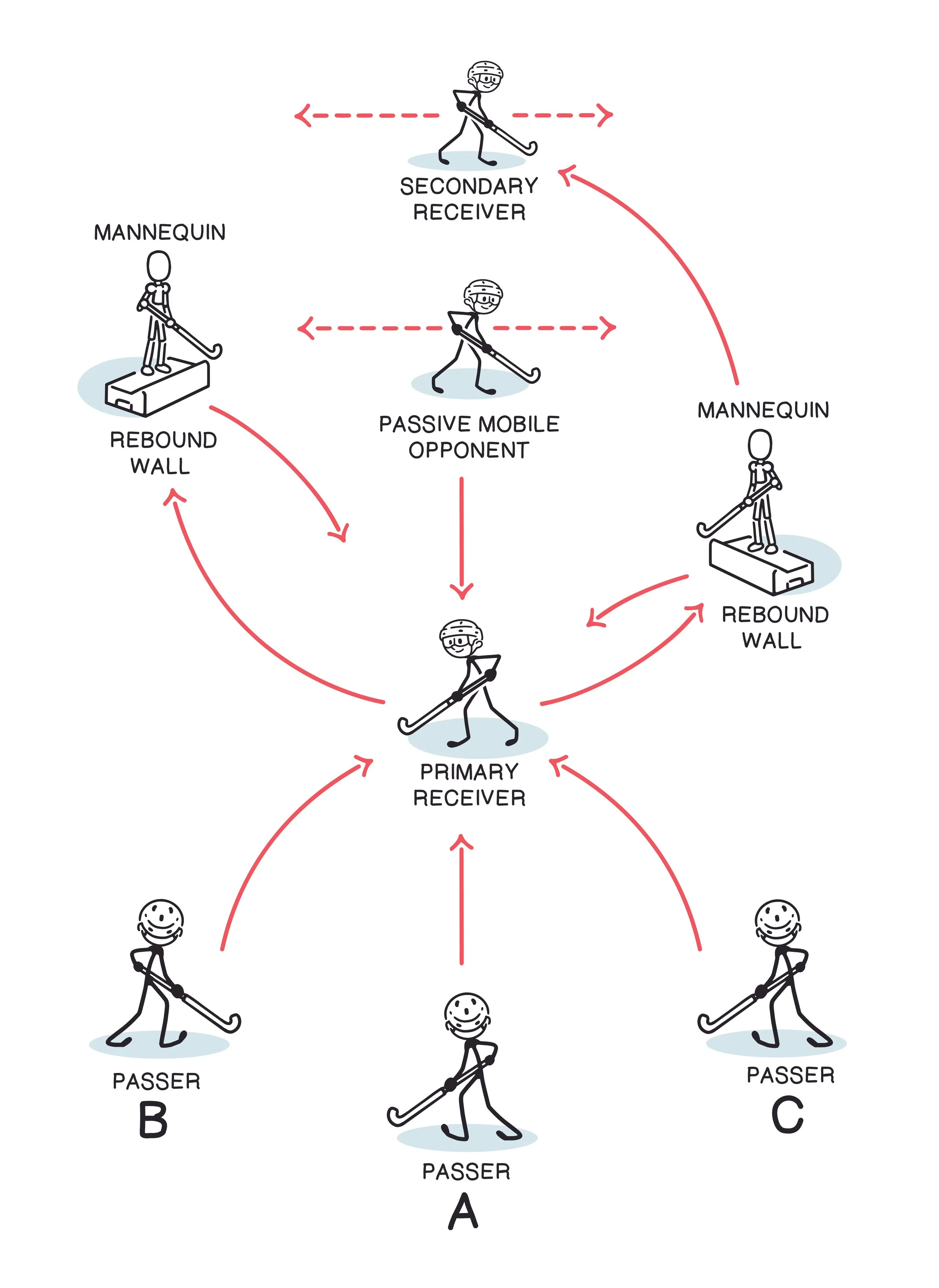
Prime Receiver (PR)
Receives a pass from Passer A,B or C moving to the ball to receive it rather than being stationary.
Upon receiving the ball they push a hard pass against the rebound wall-tyre with a mannequin and receive the rebounded return ball.
Upon receiving the rebounded ball you must thread a pass that misses the opponent in a colored bib who will jog across the passing lane between the first and a second rebound wall-tyre with a mannequin to a leading team mate who will move laterally across the space behind the second rebound wall-tyre.
Rotate roles after the PR has completed receiving at least 1 pass each from Passers A,B and C
The Science ( this may hurt the less technical )
This drill is far more than a passing pattern, it acts as a full‑stack neuromechanical activation task that loads:
visual perception
decision‑making
proprioception
CoM control
passing accuracy
timing
deception
movement preparation
reactive inhibition
and anticipatory control
…all inside a single, tightly‑designed sequence.
The First Receive
The ball can arrive from:
directly behind
left
right
This forces the receiving player to:
constantly scan
update spatial maps
adjust body orientation
prepare different receiving angles
move to the ball (not wait for it)
This activates the Dorsal Stream , sometimes referred to as the Where-How pathway. It handles motion tracking, spatial awareness, and movement guidance; comprising:
Superior Colliculus
Coordinates eye–head–body orientation toward the incoming ball.
Premotor Cortex
Prepares the receiving action based on the ball’s trajectory.
CNS Benefit
The brain must switch between three different receiving patterns. Switching = CNS priming. It increases neural excitability and readiness for match‑speed unpredictability.
Moving to the Ball to Receive
Tactically, this is to squeeze extra time and space for the receiver and possibly eliminate a marker. This enables
• CoM lowering
• foot placement
• deceleration control
• trunk alignment
• stick–ball–body integration
Biomechanically, this activates eccentric braking so the individual can slow and receive cleanly.
Hip–knee–ankle stiffness modulation is engaged to stabilise the body during the first touch.
Proprioceptive refinement is also tuned because the body must adjust to a moving ball, not a stationary one.
Rebound Pass to Tyre 1
This targets → Predictive Timing + Rate Coding
Passing into a tyre and receiving the rebound forces:
predictive modelling
timing
grip‑pressure modulation
micro‑adjustments in stick angle
rapid rate coding (fast motor unit firing)
The rebound is:
faster
less predictable
more angular
This increases:
Motor cortex activation
Because the player must prepare for a fast, hard return.
Cerebellar involvement
Fine‑tunes timing, error correction, and smoothness.
Proprioceptive load
Sharper vibrations through the stick → more sensory input → CNS up‑regulation.
Orange Bib Runner Crossing the Channel
This triggers → Reactive Inhibition + Decision‑Making
The orange bib player runs across the passing lane.
This forces the ball carrier to:
inhibit the instinct to pass early
delay action
adjust timing
maintain scanning
avoid tunnel vision
This loads:
Prefrontal Cortex
Decision‑making under time pressure.
Basal Ganglia
Reactive inhibition — stopping an action already prepared.
Dorsal Stream
Tracking moving obstacles.
This is a match‑realistic: defenders constantly cross passing lines.
Yellow Bib Receiver Appearing on Either Side
This encourages → Anticipation + Peripheral Vision
The yellow bib player appears:
left or right of the tyre
unpredictably
at variable timing
This forces the player to:
use peripheral vision
maintain head‑up posture
track two moving players
time the release
pass beyond the obstacle and the blocker
This loads:
Peripheral visual acuity
Critical for high‑speed passing.
Visuomotor integration
Linking what the eyes see to what the hands do.
Cognitive‑motor coupling
Processing movement while executing a technical skill.
Passing Beyond Tyre + Defender
This aims to elicit evolution of → Spatial Problem‑Solving + Kinetic Chain Organisation
The final pass requires:
angle selection
weight control
deception
stick‑face orientation
trunk rotation
kinetic chain sequencing
Biomechanically, this activates:
Pelvis–trunk counter‑rotation
To open the passing lane.
Ground reaction force redirection
To stabilise the body while passing around obstacles.
Fine‑motor control
To deliver a clean pass under cognitive load.
WHY THIS DRILL WORKS AS A CNS PRIMER
Because it loads:
perception (ball arrival from 3 angles)
movement (must move to receive)
timing (rebound unpredictability)
inhibition (orange bib crossing)
decision‑making (yellow bib location)
precision (final pass beyond obstacles)
anticipation (predicting movement patterns)
rate coding (fast stick control)
proprioception (stick vibrations + footwork)
This is a full‑stack neural activation drill.
It primes:
dorsal stream
cerebellum
premotor cortex
basal ganglia
motor cortex
proprioceptive pathways
The result is a player who is:
sharper
more aware
more stable
more reactive
more precise
more match‑ready
Hula Hoop CNS Activation
This is very, very simple and fun - enough to get things started pre-game or pre-session.
3 players per group
1 hula hoop
2 players stand 5m, 10m, 15m apart the 3rd player holds a hula hoop
The hoop holder dictates the pass type from:
1) over
2) through (ball must be passed at mid shin height )
3) under
keeping the hoop stationary for passes 1) and 2) and lowering the hoop to the point above the turf where a flat pass can pass easily under the hoop.
5 passes each from the 3 distances of 5n,10m and 15m before swapping roles
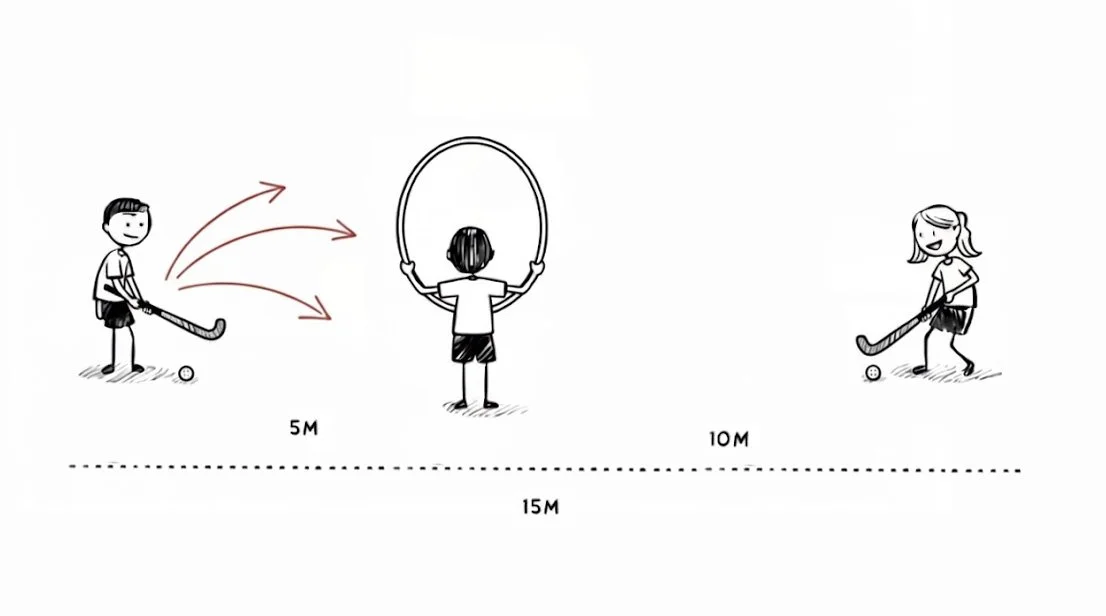
On the surface: a passing accuracy drill with a hula hoop. Under the hood we have a CNS activation task that forces:
• rapid perceptual categorisation (over / through / under)
• visuomotor mapping (different trajectories, same target)
• fine motor scaling (force, angle, stick path)
• distance‑dependent calibration (5, 10, 15 m)
It’s a solid example of low‑load, high‑neural‑density work.
Neuroscience perspective
Perceptual categorisation → faster decision channels
The hoop holder gives a variable-constraint:
Over → aerial / lifted trajectory
Through → flat, central channel to evade flat stick defensive posturing
Under → skimmed flat pass under a lowered hoop
Each cue forces the passer to:
rapidly classify the instruction
select a motor program
inhibit the others
That loads:
Prefrontal cortex: rule application (“over vs through vs under”)
Basal ganglia: action selection and inhibition
Premotor cortex: preparing the correct passing pattern
Over repeated reps, this drill sharpens stimulus → response mapping under simple but clear constraints.
Visuomotor integration → dorsal stream priming
The hoop becomes a visual gate.
The passer must:
judge hoop position in space
align stick path and ball trajectory
adjust for distance (5, 10, 15 m)
maintain accuracy while changing height and shape of the pass
That loads:
Dorsal visual stream (“where/how”) for spatial guidance
Cerebellum for timing and trajectory correction
Parietal cortex for integrating visual and proprioceptive input
You’re asking the CNS to run high‑resolution targeting at different distances and heights.
Error amplification → sharper neural adaptation
The hoop is unforgiving:
too low → hit the rim on “over”
too high / off‑line → miss “through”
too lifted → fail “under”
This creates clean, binary feedback:
success / fail
in / out
The CNS loves this—errors are obvious, corrections are immediate, learning is fast.
Biomechanical lens
Trajectory‑specific mechanics
Each pass type demands a different kinetic solution:
Over:
more wrist extension and forearm involvement
increased vertical force component
altered stick–ball contact point
Through:
pure linear drive
stable trunk
consistent follow‑through
Under:
low stick path
controlled, skimming contact
fine modulation of force to stay flat but fast
You’re training trajectory‑specific mechanics without over‑coaching them—constraints do the work.
Distance scaling → force and timing calibration
5 m vs 10 m vs 15 m:
same target
same hoop
different force, timing, and follow‑through
The passer must recalibrate:
force output (motor unit recruitment)
contact time on the ball
stick speed
release angle
This is graded motor control—a key feature of high‑level passing.
CNS activation value
Why this works beautifully as a CNS primer:
High neural load, low physical cost
Forces fast perception → decision → execution
Trains visuomotor precision at multiple distances
Uses simple constraints instead of heavy coaching
Builds passing adaptability (height, speed, angle)
You’re waking up:
dorsal stream
premotor and motor cortex
cerebellum
basal ganglia
proprioceptive pathways
Health DisclaimerThe information shared in this blog is for educational and informational purposes only. It is not intended as medical advice, diagnosis, or treatment. Always consult your primary healthcare provider before making any changes to your health, exercise, or nutrition routines — especially if you have existing medical conditions or concerns. We do not accept liability for decisions made based on this content. Your health journey is personal, and professional guidance is essential.
